AISO Tools research · data as of 2026-10-12
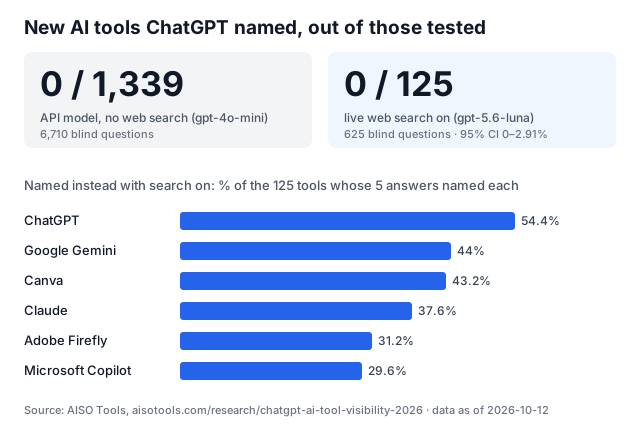
ChatGPT named 0 of 1,339 new AI tools — and 0 of 125 with live web search on
Between 2026-08-21 and 2026-10-12 we put 6,710 blind “best AI tool for…” questions to OpenAI’s gpt-4o-mini — the model behind our free visibility scan — on behalf of 1,339 AI tools that makers had just submitted to our directory. Not one of them was recommended by name. The obvious objection is that gpt-4o-mini answers from training data that predates most of these tools, so we re-asked the same questions for a random 125 of them with live web search switched on (gpt-5.6-luna). It searched the web for every answer, attached 2,079 source citations, and still named none of them.
Confidence intervals are exact (Clopper–Pearson) 95% upper bounds for zero hits: with search on, the data rule out a naming rate above about 3% of new tools per five questions, and above 0.59% per single question. The search sample is small, so “0 of 125” does not mean no new tool is ever named — it means it is rare.
With live web search on: still 0
We drew a seeded random sample of 125 tools from the 1,339, stratified by category, and asked each the same five stored questions through OpenAI’s Responses API with the web_search tool required. Of the sampled tools with a readable domain registration date, 101 of 108 were registered after gpt-4o-mini’s training cutoff — exactly the tools a search-enabled model should be able to find. It named about 12.4 products per answer (gpt-4o-mini: 6.1), but the extra slots went to incumbents too. The matcher flagged 2 answers; on review both were false positives (a generic word in a tool’s name, and an open model that a third-party site is built on). Search did reach a sampled tool’s own site 2 times (1 tool) — read, then not named or cited.
- ChatGPT54.4%
- Google Gemini44%
- Canva43.2%
- Claude37.6%
- Adobe Firefly31.2%
- Microsoft Copilot29.6%
- Perplexity28.8%
- Grammarly20.8%
- Zapier20%
- Descript18.4%
- Notion18.4%
- Midjourney16.8%
- CapCut16%
- GitHub Copilot16%
- Runway14.4%
Search changed the cast, not the outcome: the no-search list carries older names (IBM Watson, Trello, Lumen5, Integromat); with search on the leaders are general assistants (ChatGPT, Gemini, Claude, Copilot, Perplexity) and suite add-ons (Canva, Adobe Firefly, Notion).
What the search answers cited
623 of 625 answers carried at least one source link: 2,079 citations across 687 domains. The model read far more than it cited — 2,703 domains were retrieved. The most-cited domains were the incumbents’ own sites and docs and a handful of review publishers:
| Cited domain | Answers citing it | Share of 625 |
|---|---|---|
| openai.com | 63 | 10.1% |
| help.openai.com | 54 | 8.6% |
| technologyadvice.com | 51 | 8.2% |
| techradar.com | 49 | 7.8% |
| helpx.adobe.com | 37 | 5.9% |
| learn.microsoft.com | 37 | 5.9% |
| adobe.com | 33 | 5.3% |
| itechguides.com | 28 | 4.5% |
| runway.com | 28 | 4.5% |
| arxiv.org | 26 | 4.2% |
| g2.com | 20 | 3.2% |
| developers.openai.com | 19 | 3% |
| docs.midjourney.com | 19 | 3% |
| news.adobe.com | 18 | 2.9% |
| zapier.com | 17 | 2.7% |
Reddit is read, not cited. A Reddit thread was retrieved for 595 of 625 answers (95.2%) but cited in only 8. Wikipedia (read in 291 answers, cited in 5) and YouTube (313, cited in 2) follow the same pattern.
Directories barely register. G2 was the most-cited directory (26 answers, counting its subdomains). The big AI-tool directories — Futurepedia, There’s An AI For That, Toolify, FutureTools, AlternativeTo — were cited in none of 625 answers. Our own directory, aisotools.com, was retrieved 9 times and cited zero times. Smaller “AI ranking” list sites (toolradar, toolmapr, toolcenter, theairankings) were cited a few times each. For a maker, a directory listing is useful for people browsing it; in this data it is not a path into a ChatGPT answer.
Who gpt-4o-mini names instead (no search, all 1,339 tools)
Share of the 1,339 tools for which each product appeared in at least one of the five blind answers. These are factual observations of what the model answered, not our ranking of the products.
- Runway26.7%
- ChatGPT26.5%
- IBM Watson21.6%
- Canva16.7%
- Grammarly16.4%
- Notion16.2%
- Zapier13.5%
- Trello13.2%
- Lumen513%
- Pictory12.7%
- DALL·E12.6%
- Synthesia12.6%
- Artbreeder11.8%
- DeepAI11.7%
- DeepBrain AI11.3%
On the newer buyer-job questions alone (n = 437 tools), the leaders were Canva (19.7%), Runway (16.7%), ChatGPT (14.6%), and Lumen5 (12.4%).
By category: same question, same answer
Until 2026-10-02 every tool in a category was asked the same five category questions. That makes each category a repeat experiment: the right-hand column shows how often each top product appeared across those repeated runs. Categories with fewer than 20 tools are merged into “Other”; where fewer than 20 repeat runs exist we don’t report rivals.
| Category | Tools | Named | Most-named instead (share of repeat runs) |
|---|---|---|---|
| Video & Animation | 172 | 0 | Lumen5 100% · Pictory 100% · Runway 100% |
| Productivity | 166 | 0 | Grammarly 100% · Microsoft Copilot 100% · Notion 100% |
| Image Generation | 161 | 0 | Artbreeder 100% · DALL·E 100% · Runway 100% |
| Business & Finance | 101 | 0 | IBM Watson 100% · Tableau 100% · QuickBooks 89% |
| Marketing & SEO | 91 | 0 | Semrush 98% · Ahrefs 95% · MarketMuse 95% |
| Education & Research | 83 | 0 | ChatGPT 96% · Grammarly 94% · Zotero 90% |
| Audio & Music | 74 | 0 | Descript 100% · AIVA 96% · Amper Music 94% |
| Chatbots & Assistants | 69 | 0 | ChatGPT 100% · Dialogflow 100% · IBM Watson 100% |
| Design & UI/UX | 68 | 0 | Canva 100% · Figma 100% · Looka 100% |
| AI Agents & LLM Infrastructure | 62 | 0 | Hugging Face 100% · Rasa 93% · OpenAI API 82% |
| Writing & Content | 58 | 0 | ChatGPT 100% · Copy.ai 100% · Grammarly 100% |
| Other (categories with <20 tools, merged) | 52 | 0 | mixed categories — not reported |
| Data & Analytics | 45 | 0 | Alteryx 92% · DataRobot 85% · Tableau 73% |
| Coding & Development | 45 | 0 | Codeium 100% · DeepCode 100% · GitHub Copilot 100% |
| Automation & Workflows | 35 | 0 | IFTTT 100% · Integromat 100% · Microsoft Power Automate 100% |
| Healthcare & Wellness | 33 | 0 | IBM Watson 100% · Zebra Medical Vision 100% · Babylon Health 95% |
| Search & Knowledge | 24 | 0 | only 18 repeat runs — not reported |
“Repeat runs” = tools asked the category-template questions (n per category is in the CSV). Tool counts include both question types.
How crowded each answer set is
Across a tool’s five answers the model named a median of 13 distinct products. A new tool is not competing for an empty slot: it needs to displace one of roughly a dozen names the model already reaches for.
Does an older domain help?
OpenAI lists gpt-4o-mini’s training-data cutoff as October 2023, so a product launched after that is structurally hard for it to know. We looked up each tool’s domain registration date. Of the 1,187 tools with a readable date, 1,063 registered their domain on or after 2023-10-01 (833 in 2026 alone) and 124 before it. Neither group was named even once (29 more run on free-hosting subdomains or platform pages; 123 have no public registration date). An older domain is not the same thing as an older product, so treat this as a weak test — but in this sample it made no visible difference. The web-search cohort above is the stronger test of the same question: there the model could look the new tools up, and still did not name them.
What this means if you make an AI tool
The headline is not that new tools are bad. It is that a language model answering from memory recommends what was famous in its training data, and repeats it with remarkable consistency. When we asked the identical video questions over a hundred times, the same three video products appeared essentially every time. A tool that launched this year simply isn’t in that memory, however good it is.
The second thing the data shows is how little the question wording rescued anyone. In October we switched the scan from generic category questions (“best AI tool for Productivity”) to the specific job each tool does (“best AI tool for pdf comparison”). Narrower questions changed who was named — the incumbent list got more specific — but still produced 0 recommendations out of 437 tools.
Several names in the answers also show the age of the model’s knowledge: Integromat, for example, was renamed Make in 2022, yet it is still among the most-named automation tools here. Turning web search on fixes that staleness — the search answers name current products and cite 2026 pages — but it did not let a single new tool in. Search retrieves what is already written about a category: incumbents’ docs, review roundups and Reddit threads. A new tool gets named when those pages name it, which is why the useful number for a maker is not a single score but whether it moves: whether the assistant your buyers use starts naming you, and which incumbent you are being compared to while it doesn’t.
Is ChatGPT naming your tool?
Run the same blind questions for your own product — free, no card. You’ll see whether you were named and exactly which tools were named instead. If you want to watch that change month to month, monitoring is a free trial, then $19/mo.
Methodology
- Cohort 1 (no search): OpenAI gpt-4o-mini via the Chat Completions API, temperature 0.7, with a system prompt asking it to recommend tools the way ChatGPT normally would. No web browsing or search tool was enabled, so this measures the model’s built-in knowledge. All 1,339 tools.
- Cohort 2 (web search): OpenAI gpt-5.6-luna via the Responses API on 2026-10-12, with the web_search tool required on every answer (so each answer is grounded in a live search), reasoning effort low, default search context size, and no system prompt — just the question, as a user would type it. Sample: 125 tools drawn at random from the 1,339, proportionally stratified by category (seed 20261012), each asked its same five stored blind questions once (625 answers, all completed). “Named” = the same name matcher as cohort 1 over the full answer, plus the tool’s domain anywhere in the answer text or its citation links; both flagged answers were checked by hand and rejected. Products named instead come from the answer’s list items, bold product names in tables and headings, with obvious aliases merged. “Cited” = inline source links in the answer; “retrieved” = pages the search tool returned to the model.
- Questions: five per tool, none containing the tool’s name. Scans before 2026-10-02 (902 tools) used the directory category: “Best AI tool for X”, “What AI tool do you recommend for X?”, “Top AI tools for X in 2026”, “I need an AI tool for X, what should I use?”, “Most popular X AI tools”. From 2026-10-02 (437 tools) X is the buyer job read from the tool’s homepage. A handful of paid deep scans asked eight blind questions; only their blind questions are counted.
- Sample: AI tools submitted to the AISO Tools directory by their makers and approved by our triage (real, reachable, English-language AI products), scanned 2026-08-21 to 2026-10-12. One scan per tool — the latest. Final n = 1,339.
- Excluded from 1,799 scan rows: 38 our own test probes, 5 scans of our own sites, 50 with no valid URL, 238 not matching an approved directory listing (junk, rejected or well-known tools typed in by visitors), 3 without a completed scan, 125 repeat scans of the same tool, and 1 whose name appeared inside its own question.
- “Named”: a word-boundary match of the tool’s name in the answer, then checked by hand. The matcher flagged 4 tools; all 4 were false positives — a generic word in the name (“clarity”, “business”) or a name shared with an older, unrelated product. We also searched every answer for each tool’s domain name and found no missed recommendations.
- Products named instead are parsed from the answer’s list items, with list headings that aren’t products (“Pricing”, “Ease of use”) removed and obvious aliases merged. Some noise will remain at the long tail; the top entries were checked by hand.
- Limitations: one model, one temperature, five questions per tool, and a sample of makers who chose to list on our directory — mostly small, recent launches, not a random sample of AI products. Results for Perplexity, Gemini or Claude may differ. The search cohort is an API model with OpenAI’s web_search tool, the closest reproducible equivalent of ChatGPT with search; the ChatGPT app may use a different model, search settings, memory or personalisation. It is 125 tools, not 1,339, so its upper bound is wider. Domain registration date is a rough proxy for product age.
Use this data
Free to cite and republish with a link (CC BY 4.0). Download the aggregate CSV — aggregates only, no maker emails or tool URLs.
AISO Tools (2026). "ChatGPT named 0 of 1,339 new AI tools — and 0 of 125 with live web search on." https://aisotools.com/research/chatgpt-ai-tool-visibility-2026 — no search: n=1,339 tools, 6,710 questions, 2026-08-21 to 2026-10-12; web search: n=125 tools, 625 questions, 2026-10-12.
<a href="https://aisotools.com/research/chatgpt-ai-tool-visibility-2026"><img src="https://aisotools.com/research/chatgpt-ai-tool-visibility-2026.svg" alt="ChatGPT named 0 of 1,339 new AI tools without search and 0 of 125 with web search on — AISO Tools" width="640"></a>
Questions about the data: shibley@apistatuscheck.com. Snapshot dated 2026-10-12; numbers will not change on this page without a new date.